
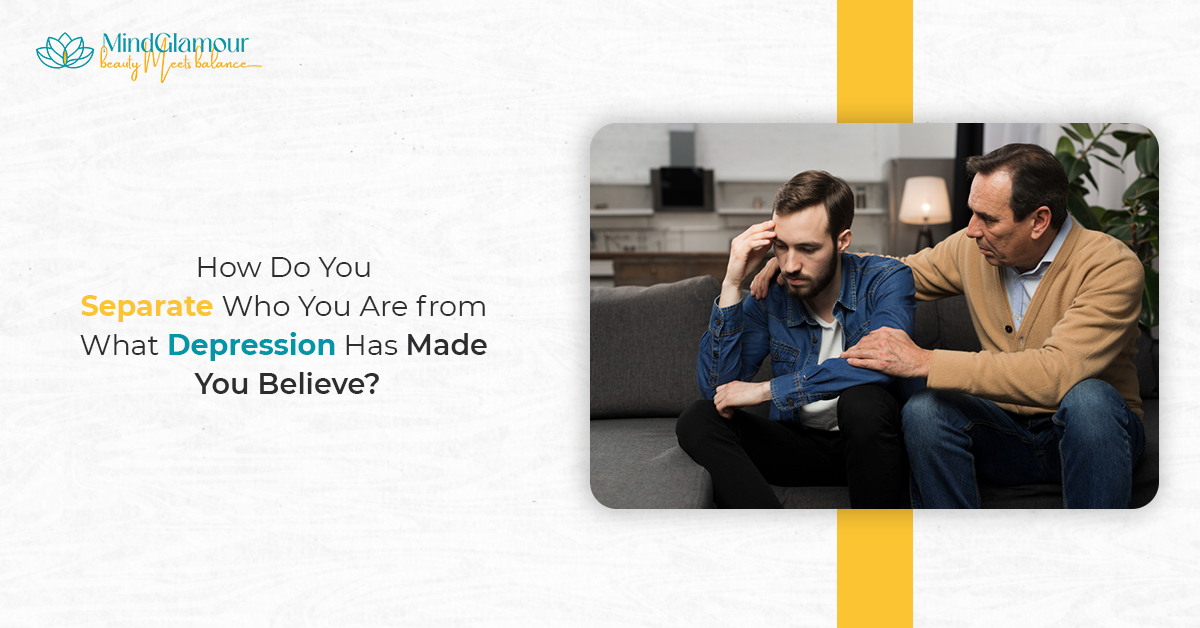
When depression persists long enough, it ceases to be something distinct. It just becomes how you think.
The voice in your head that tells you that you are not good enough or things are not going to get better – at some point, you eventually think that is you being realistic.
How you see yourself right now might have less to do with who you are. It has more to do with depression warping everything.
The Stories Depression Tells
Depression is a terrible storyteller, but it’s convincing. It takes one bad day and turns it into “you always fail.” It takes one mistake and makes it proof that you’re fundamentally broken.
The worst part? These thoughts don’t feel like symptoms. They feel like realizations. As though you are only beginning to see the reality about yourself. But you’re not. You’re just seeing depression’s version of you.
Some of the greatest hits include:
- You’re too much work for people to deal with
- You’ve wasted so much time already
- Other people have it worse, so you shouldn’t complain
- This is just who you are now
None of these are facts. They’re symptoms with really good PR.
Learning to Spot the Difference
Figuring out what’s you and what’s depression isn’t some instant revelation. It takes practice. You get better at it over time.
The Language Matters
Pay attention to absolutes. “I never do anything right” isn’t usually true. It’s just how depression talks.
Your real life has good days and bad days. Depressive thinking erases the good ones and only shows you the bad.
Look at the Timeline
Here’s something depression does: it rewrites your history. You’ve probably had good days, proud moments, times when you felt capable. Depression just doesn’t want you remembering them right now.
Those experiences didn’t stop being real just because you feel terrible today. They’re still part of your story, even when depression tries to edit them out.
Getting Yourself Back
You don’t wake up one day and suddenly know who you are again. It’s quieter than that.
Stop Fighting and Start Noticing
Positive thinking doesn’t work when you’re depressed. It just frustrates you.
Try noticing when the negative stuff comes up. You don’t need to argue with it. You don’t have to force yourself to think differently. Just acknowledge it’s happening.
Recall Your Priorities
Before depression took up so much of mental space, what seemed really important to you?
What made you feel alive?
You probably can’t act on those things right now, and that’s fine. Just knowing they exist helps. It reminds you that there’s a version of you that exists outside this feeling.
Write Things Down
Depression has selective memory. It remembers every failure and forgets every success. So keep your own records:
- Text someone when you do something hard, even if it’s just getting out of bed
- Screenshot compliments before depression convinces you people were just being nice
- Write down moments when you felt even slightly okay
This isn’t about gratitude journals or forced positivity. It’s about having proof when depression tries to tell you nothing good ever happens.
Recognizing When You Need Assistance
It’s not a personal shortcoming when you can’t accomplish this on your own.
If the voice of depression is all you can hear lately or if you are considering self-harm, and if you just feel lost, then you should get help from a professional.
What Happens Next
When you wake up tomorrow, it’s unlikely that you’ll have a complete understanding of everything. You’re just going through something. It isn’t linear.
The point is to slowly build back your ability to recognize yourself when depression isn’t in the way.
You’re still in there. Depression just takes up a lot of room.
Find more honest conversations about mental health and practical support for your journey at Mind Glamour.
FAQs
Will I ever feel like myself again?
Most people do but it takes time. You’re still you. Depression is just making it harder to see that right now.
How do I know if a thought is mine or depression’s?
It is probably depression if that thought is:
- Negative
- Harsh
- Absolute
- Overall hopeless
Even in difficult situations, your true feelings usually appear more balanced.
What happens if I can’t recall my previous identity?
That is typical of chronic depression. Try finding out how you were like from those who had previously known you.
